
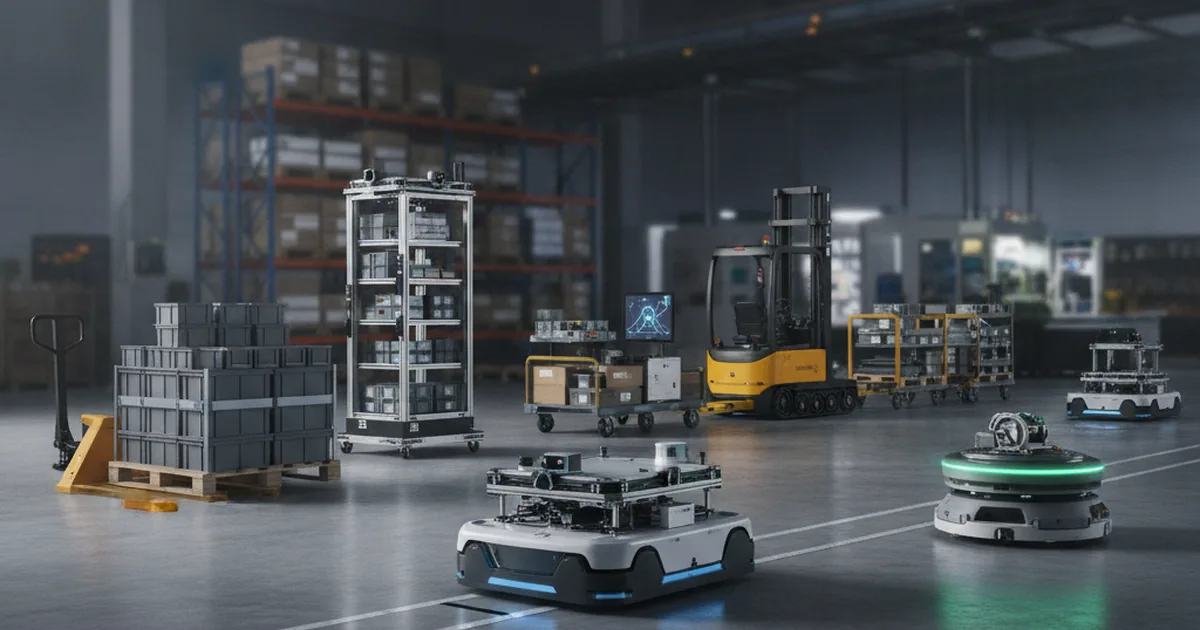
VDA 5050 is a standardized interface, developed by VDA and VDMA, that lets a single fleet manager command AGVs and AMRs from different vendors using the same message types over MQTT. Version 3.0 (March 2026) added zone-based coordination and expanded error levels, but the standard still doesn't define maps, safety models, or fault-recovery, so mixed-fleet plants still need a dedicated integration layer between fleet managers and WMS/MES.
Picture a warehouse running AGVs from one vendor for pallet transport and AMRs from two other vendors for piece-picking and inspection. Each robot brand ships its own fleet manager, speaking its own proprietary protocol, which means none of the three systems can see what the others are doing. Robots cross paths in the same aisle without knowing it, two fleet managers route separate robots to the same staging zone, and tasks get duplicated because no single system has a complete picture of the floor.
That kind of multi-vendor mess is exactly what VDA 5050 was built to address, and the standard has been widely adopted for a reason. But getting a VDA 5050-compliant fleet manager talking to robots is only half the job: the other half is getting that fleet manager talking to the warehouse management or manufacturing execution system that actually decides what work needs doing: exactly the kind of multi-system API integration work a dedicated development team handles when a fleet manager needs to talk to a WMS that was never built with VDA 5050 in mind. This piece covers how the standard works, what changed in its latest version, where it stops, and what a practical integration layer actually needs to do, alongside a related look at how collaborative robots get integrated into production lines safely, a problem that shares much of the same coordination logic.
What Problem Does VDA 5050 Actually Solve?
Before a common standard existed, every AGV or AMR vendor shipped its own proprietary communication protocol between its robots and its own fleet manager. That worked fine as long as a plant bought every robot from one vendor, but almost no plant stays that way for long. Different zones need different robot types, vendors get swapped out, and expansion phases bring in new hardware that doesn't speak the same language as what's already running.
VDA 5050 is a standardized interface for communication between a fleet manager (sometimes called master control) and the AGVs or AMRs it directs. Crucially, it isn't a single vendor's proprietary spec dressed up as an open standard: it's developed jointly by the German VDA (Verband der Automobilindustrie, the automotive industry association) and VDMA (the mechanical engineering association), together with industrial partners. That joint, multi-company development is what makes it credible as a genuine common language rather than one company's attempt to lock in the market.
Inside the Standard: Message Types and Transport
VDA 5050 runs over MQTT, a lightweight publish-subscribe messaging protocol already common across industrial IoT deployments, a practical choice since it's cheap to implement, handles frequent small messages well, and most plants already have MQTT infrastructure somewhere in their stack. On top of that transport, the standard defines a small set of message types that carry the actual communication between fleet manager and robot:
- order: the fleet manager sends a robot its task: where to go, what to pick up, what sequence of nodes and edges to follow.
- state: the robot reports back its status, position, battery level, and any errors in near-real time.
- instantAction: a one-off command outside the normal order flow, such as "lift fork," "slow down," or "pause," introduced in version 2.0.
- factsheet: also added in version 2.0, this is how a robot describes its own capabilities (dimensions, top speed, load capacity) to the fleet manager when it first connects, so the fleet manager knows what the robot can actually do.
- connection and visualization: supporting messages that report connection status and robot position for monitoring dashboards, separate from the operational order/state exchange.
Together, those message types give a fleet manager everything it needs to assign work, track progress, and react to problems, regardless of which vendor built the robot receiving the order, as long as that robot implements the same message schema.
What's New in Version 3.0 (March 2026)
VDA 5050 version 3.0, published in March 2026, extends the standard in a few specific directions. It adds zone-based coordination, letting a fleet manager define traffic zones that robots must request access to before entering, a direct answer to the collision and congestion problems that come up when multiple robots share the same physical space. It also adds path sharing, so robots and the fleet manager can negotiate overlapping routes rather than simply blocking each other out. On the fault-handling side, version 3.0 introduces more granular error levels (Warning, Urgent, Critical, and Fatal), replacing a flatter error model with one that lets a fleet manager (and a human operator) triage problems by actual severity instead of treating every fault the same way. The version also extends support toward freely navigating robots, those that plan their own paths dynamically rather than following a fixed trajectory, while keeping backward compatibility with the trajectory-based approach older AGVs use.
One practical caveat worth flagging: a new version of the standard doesn't mean a new version of your fleet. As of late 2026, most production deployments still run on VDA 5050 version 2.0 or 2.1, not 3.0, since the standard's release cadence is simply faster than the replacement cycle for physical robots and fleet-manager software already installed on a factory floor.
Is VDA 5050 Compliance Enough on Its Own?
No, and this is the point that gets glossed over in vendor marketing. Two robots that both claim VDA 5050 compliance can exchange well-formed order and state messages and still fail to work together safely or efficiently, because the standard deliberately leaves several things undefined. There's no unified map format, so a fleet manager still has to reconcile each robot's internal representation of the floor with a shared reference. There's no common safety model across vendors, so collision-avoidance behavior at the edges of a shared zone can differ between robot brands even when both speak VDA 5050. And there's no standardized fault-recovery coordination: when one robot in a mixed fleet stops working mid-task, the standard doesn't define how the rest of the fleet, or the fleet managers overseeing different vendor groups, should jointly respond.
In other words: VDA 5050 compliance is a necessary condition for multi-vendor interoperability, not a sufficient one. It removes the proprietary-protocol barrier at the communication layer, but the coordination, safety, and recovery logic still has to be built on top.
Where the Integration Work Actually Happens
Bridging the Fleet Manager to WMS and MES
The gap VDA 5050 leaves open is exactly where a dedicated integration layer earns its keep. A fleet manager that's VDA 5050-compliant on the robot side still needs to connect to the systems that actually decide what work needs doing, the WMS that tracks inventory and orders, or the MES that sequences production tasks. That connection is not part of the VDA 5050 standard at all; it's a separate integration problem, and it usually involves normalizing messages from multiple fleet managers (if the plant runs more than one), mapping WMS tasks into VDA 5050 orders, and aggregating robot status from different vendors into one operational dashboard.
Legacy WMS platforms are a particular sticking point here: many were never built to speak MQTT or VDA 5050 natively, so a translator layer has to sit between the legacy system's native interface and the robot-facing side of the stack. That same translator-layer problem shows up in other industrial messaging contexts too, as covered in our deep dive on MQTT and Sparkplug B for industrial IoT.
A Practical Rollout Sequence
A practical rollout of this unified integration layer tends to follow a consistent sequence:
- Inventory the protocols in use today: list every robot fleet manager on the floor and which VDA 5050 version (if any) each one actually implements.
- Define a single integration point: an API gateway that all fleet managers and the WMS/MES connect through, rather than point-to-point links between every pair of systems.
- Map message schemas both ways: translate WMS/MES task definitions into VDA 5050 orders, and translate robot state/factsheet messages back into whatever format the business systems expect.
- Test shared-zone and priority behavior under load: verify that zone requests, path sharing, and task priority actually resolve correctly when multiple vendor fleets are active at once, not just in a single-vendor pilot.
- Monitor and expand incrementally: roll new robot types or vendors into the integration layer one at a time, watching for schema mismatches before they reach the full floor.
Key Takeaways for Plant IT Teams
- Check which VDA 5050 version each current or prospective vendor actually implements ("VDA 5050 compliant" alone doesn't tell you the feature set).
- Don't confuse protocol compliance with full interoperability; zones, safety, and fault-recovery still need engineering beyond the standard.
- Budget for the integration layer as its own line item, separate from the cost of the robots and fleet-manager licenses themselves.
- Require factsheet-message compatibility when evaluating a new vendor, so the fleet manager can actually interpret the robot's declared capabilities at connect time.
FAQ
- What is VDA 5050 in simple terms?
- VDA 5050 is a standardized communication interface between a fleet manager (master control) and the automated guided vehicles or autonomous mobile robots it directs. Instead of each robot vendor using its own proprietary protocol, a VDA 5050-compliant robot and fleet manager exchange the same message types (orders, status updates, and action commands) over MQTT.
- Is VDA 5050 a protocol or a standard?
- It's a communication standard, developed jointly by the German associations VDA and VDMA together with industrial partners. It defines the message formats and transport (MQTT) that a fleet manager and a robot must support to interoperate; it isn't owned or controlled by a single robot vendor.
- Which version of VDA 5050 is actually used in practice?
- Version 3.0, released in March 2026, is the current release and adds zone-based coordination, path sharing, and expanded error levels. In practice, most deployed fleets still run on version 2.0 or 2.1, since the standard's release cadence moves faster than fleets of physical robots get upgraded or replaced.
- Can VDA 5050 replace a fleet manager entirely?
- No. VDA 5050 standardizes the interface between a fleet manager and robots; it doesn't replace the fleet manager itself, which still handles task assignment, routing, and traffic logic. A plant still needs a fleet manager (or several, bridged together); VDA 5050 just lets that software talk to robots from more than one vendor through one interface.
- What happens if a robot doesn't support VDA 5050?
- A non-compliant robot has to be integrated through its own proprietary API or SDK, outside the common interface. That's exactly the scenario VDA 5050 was built to reduce, but older AGV fleets and some AMR platforms still ship without it, which means a mixed-fleet integration layer typically has to speak both VDA 5050 and one or more vendor-specific protocols at once.
- Why does VDA 5050 use MQTT as its transport?
- MQTT is a lightweight publish-subscribe messaging protocol already common in industrial IoT, which makes it a practical fit for frequent, small status and order messages between a fleet manager and many robots. Using an existing, widely supported transport instead of inventing a new one also makes VDA 5050 easier for vendors to implement on top of infrastructure they likely already run.
- Does VDA 5050 solve robot-to-robot safety during shared operation?
- Not fully. VDA 5050 version 3.0 added zone-based coordination and path sharing, which help fleet managers avoid collisions and congestion, but the standard doesn't define a unified safety model across vendors or a shared fault-recovery process. Compliance with VDA 5050 means two robots can exchange compatible messages; it doesn't by itself guarantee a coordinated, safe response when something goes wrong.
For the broader integration patterns that sit behind this kind of fleet-to-business-system bridge, see our guide to industrial API gateway architecture.
Need to bridge a VDA 5050 fleet manager with your WMS or MES? Discuss Custom API Integration →