
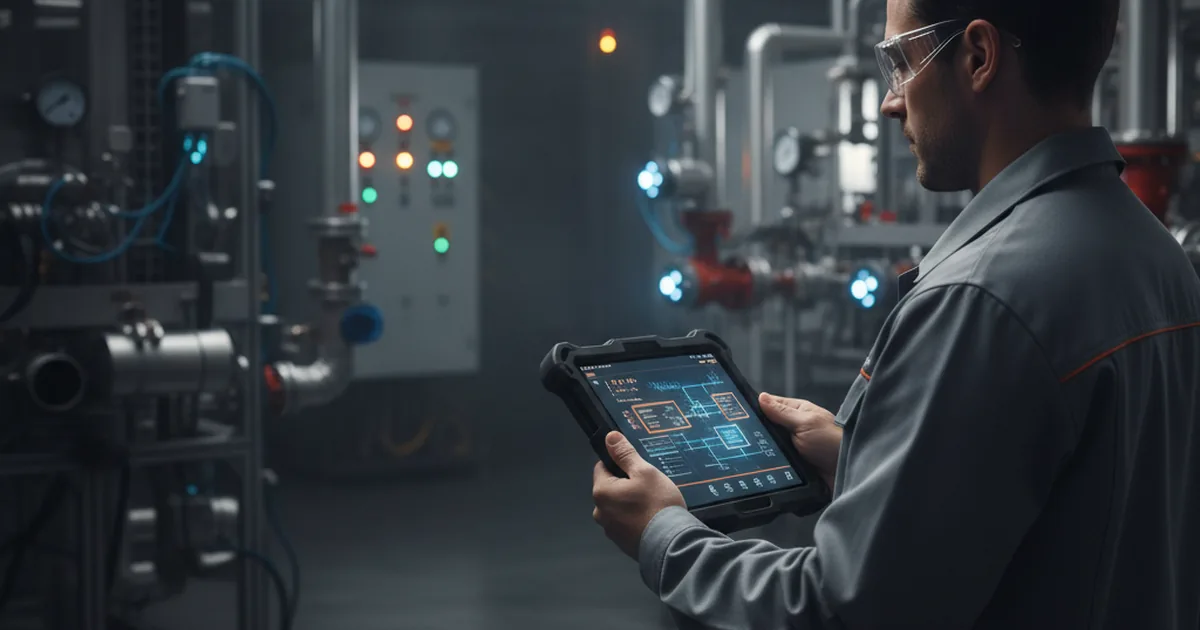
Connected worker platforms sit between the shop floor and MES/ERP, turning paper-based work instructions into guided digital workflows with offline-capable data capture. This guide covers the core architecture (task engine, forms layer, integration patterns with MES/SCADA, and the RBAC model), plus a build-vs-buy framework for engineering teams evaluating the category.
Most manufacturers still run frontline work on some mix of printed travelers, laminated job-aid binders, and whatever an operator remembers from training three years ago. The gaps show up as inconsistent execution between shifts, inspection evidence that exists only as a checked box with no photo behind it, and a maintenance team that finds out a step was skipped only after the defect reaches final inspection. A connected worker platform (CWP) is the software category built to close that gap: digital work instructions, structured forms, and evidence capture delivered to the operator at the point of work, with the resulting records flowing back into the systems that already run the plant.
This is a technical breakdown for engineering teams evaluating or building this category, not a buyer's shortlist. It covers the four architectural layers every CWP needs, why offline-first design is structural rather than a nice-to-have, the data model and access-control decisions that are easy to get wrong, and where a CWP's responsibility ends and the MES's begins. Getting the integration layer right is usually the hardest part of the build, and it is usually best handled by a manufacturing software development company that already understands MES/ERP integration patterns. The architecture below applies whether you buy a packaged platform or build one: the layers don't change, only who implements them does.
What a Connected Worker Platform Actually Does on the Shop Floor
The Problem It Solves: Paper, Tribal Knowledge, and Disconnected Systems
Three failure modes keep showing up across plants that haven't digitized frontline work. First, instructions drift: a printed traveler gets revised, but the stack already on the floor doesn't, so operators on different shifts are working from different versions of the same procedure. Second, evidence is thin: a checkbox confirms a step happened, but there's no photo, no reading, no signature behind it, so when a quality escape happens weeks later, there's nothing to audit. Third, knowledge is tribal: the fastest route to "how do I actually do this" is finding the senior operator who's been running that line for a decade, which doesn't scale and walks out the door at retirement.
A CWP addresses all three by making the digital work instruction the single source of truth, capturing structured evidence at the moment the work happens instead of after the fact, and making expert knowledge (the annotated photo, the known-good torque sequence, the "if you see this, do that" note) available inline rather than locked in one person's head.
Where It Sits in the Plant Software Stack (CWP vs MES vs SCADA vs LMS/EHS)
A CWP doesn't replace any of the systems already running a plant; it sits alongside them as the interaction layer operators touch directly. The table below shows where each system's responsibility starts and stops.
| System | What it owns | What it does NOT own |
|---|---|---|
| MES | Production orders, routings, genealogy, the authoritative "what was built" | How the instruction is presented to an operator at the workstation |
| SCADA / historian | Live process and sensor values, control-loop state | Human-task sequencing or structured evidence from a person |
| Connected worker platform | Task sequencing, guided work instructions, form-based evidence capture at the point of work | Production scheduling or the system-of-record for genealogy |
| LMS / EHS | Training records, certifications, incident and safety-observation tracking | Day-to-day task execution on the floor |
In practice a mature deployment has the CWP checking an operator's training-record status from the LMS before unlocking a task, pulling a live sensor reading from SCADA into a form field, and writing the completed work record back to the MES, without owning any of those three systems itself.
Core Architecture: The Four Layers of a Connected Worker Platform
Strip away the UI and every CWP, packaged or custom, is built from the same four layers. Understanding them separately matters because each one fails differently, and a platform that's strong in one layer can still be unusable in production if another layer is weak.
Task and Workflow Engine
The task engine is what decides which step an operator sees next, based on the work order, the equipment, the operator's role, and what's already been completed. A thin implementation is a linear checklist. A real one supports conditional branching (for example, "if the reading is out of tolerance, skip to the rework path instead of the next standard step") and can sequence across multiple operators on the same work order, which matters the moment a task hands off between a line operator and a quality inspector.
Structured Forms and Evidence Capture
This is where tribal knowledge becomes an auditable record. A structured form isn't a free-text box; it's a defined set of fields (numeric readings with tolerance bounds, photo capture tied to a specific step, electronic signatures, barcode or RFID scans for part and lot traceability), each one mapped to a schema the downstream system can consume without a human re-keying it. The failure mode to design against is the form that technically captures data but produces nothing usable: a photo with no required annotation, a free-text field standing in for what should be a bounded numeric input.
Rules Engine and Escalation Logic
Capturing data is only half the job; the platform also needs to act on it in real time. A rules engine evaluates form inputs and sensor values against defined thresholds and triggers escalation (notify a supervisor, lock the next step, open a non-conformance record) the moment a reading falls outside tolerance, rather than waiting for someone to notice on a report the next day. This is also where safety logic lives: a lockout-tagout confirmation step that won't let an operator proceed without an explicit, logged acknowledgment.
Integration Layer: MQTT/Sparkplug B, OPC UA, REST/Webhooks into MES/ERP/SCADA
The integration layer is where most of the real engineering effort goes, and it's also where packaged platforms most often fall short for plants with non-standard systems. Two distinct transport patterns matter here. Streaming sensor and process data typically arrives over MQTT and Sparkplug B, the standardized namespace and birth/death lifecycle that let a CWP subscribe to live values without hand-building a parser per data source. Transactional data, meaning completed work records, work-order status, and form submissions, moves through REST APIs or webhooks into the MES or ERP, usually as discrete, acknowledged transactions rather than a continuous stream. A platform that tries to force both kinds of traffic through the same transport pattern tends to end up either flooding the MES with chatty updates or missing real-time sensor context it needed to pull into a form.
Why Offline-First Design Isn't Optional on a Factory Floor
Plant Wi-Fi is rarely uniform. Dense metal equipment, RF interference from motors and welders, and basement or mezzanine areas routinely create dead zones that a corporate office network never has to account for. A CWP built on the assumption of constant connectivity will simply stop working for operators standing in those zones, which, on most floors, is not a rare edge case.
Edge Buffering and Sync Conflict Resolution
Offline-first means the client downloads the active work package (instructions, forms, reference data) before the operator needs it, lets them complete and locally queue records with no live connection, and syncs once connectivity returns. The harder engineering problem is conflict resolution: if two operators handling the same work order both go offline and both submit conflicting records, the sync layer needs a deterministic rule for which record wins, or at minimum a clear flag that surfaces the conflict to a supervisor instead of silently overwriting one submission with the other.
Network Segmentation and OT/IT Boundary Considerations
CWP clients on the floor often need to reach both an OT network segment, for live sensor pulls, and an IT-side MES/ERP endpoint, for record sync. That puts the platform squarely on the OT/IT boundary that plant network architects are usually trying to keep tightly controlled. The practical implication is that the integration layer needs to be designed with the plant's network segmentation in mind from day one, not bolted on after a security review flags unrestricted north-south traffic between the shop floor and the data center.
Data Model and RBAC: What Engineering Teams Need to Get Right
Linking Records to Asset, Order, Shift, and Person
A completed-work record that isn't reliably linked to the specific asset, work order, shift, and operator it belongs to is close to useless for root-cause analysis later. This sounds obvious until a plant actually tries to reconstruct, six weeks after the fact, exactly who performed a step on exactly which machine during a shift change, and finds the record only captured "line 3" and a date. The data model needs those four relationships as first-class, required fields on every record, not optional metadata added after the fact.
Role- and Shift-Based Access Control
Access control on a shop floor isn't just "who can log in": it's who can see which work orders, who can approve a deviation, and who can modify a submitted record versus only view it. Role-based access typically isn't enough on its own; shift-based scoping matters too, since a night-shift operator generally shouldn't have standing access to day-shift work orders they had no part in, and a supervisor's approval authority commonly needs to be scoped to the shift or line they actually manage rather than the whole plant.
Connected Worker Platform vs MES: Where the Line Actually Is
The confusion between CWP and MES is common enough to be worth addressing directly, because the two categories genuinely overlap at the edges. An MES is the system of record: it owns production orders, routings, and genealogy, and its job is to answer "what did we build, when, under which order, with which materials." A CWP is the interaction layer: it owns how the instruction is presented to the operator and how the evidence of doing the work gets captured. In a well-architected deployment, the CWP consumes the work order from the MES, guides the operator through it, and writes the completed record back; it does not try to become a second system of record alongside the MES.
Where teams get this wrong is building (or buying) a CWP that duplicates MES functionality, including its own work-order scheduling and its own genealogy tracking, instead of integrating with the MES that already does that job. That duplication is exactly the kind of decision covered in more depth in our Custom MES vs Off-the-Shelf framework, which applies the same build-vs-buy logic from the MES side of this boundary.
Build vs Buy: A Framework for Engineering Teams
The decision rarely comes down to cost alone. It comes down to how well your actual workflows, equipment mix, and existing system landscape fit a vendor's assumptions.
When Off-the-Shelf Covers the Need
A packaged CWP is usually the right call when your task and form structures map cleanly onto standard templates, your integration surface is one or two mainstream MES/ERP platforms the vendor already has a connector for, and you don't need the platform to sit inside a larger custom system. For a single plant running a well-known ERP and standard discrete-manufacturing workflows, the fastest path to value is almost always buying.
When Custom Integration Is the Right Call
The calculus shifts once any of three things are true: your MES or ERP is a proprietary or heavily customized system a packaged CWP's connector library doesn't cover, your process logic includes non-standard branching or evidence requirements a vendor's form builder can't express without workarounds, or the CWP needs to integrate into a broader custom system, such as a multi-site EAM/CMMS rollout, a supplier-facing portal, or a proprietary quality platform, where a packaged product's API surface stops short of what the integration actually requires. In those cases, the integration work becomes the project, regardless of which CWP product sits in front of the operator, and it's worth treating the build the same way you'd treat any other custom industrial software project rather than assuming a vendor's standard implementation package will absorb the gap.
Rolling Out a Connected Worker Platform Without Breaking the Floor
The rollout risk isn't the software; it's disrupting production while you're trying to replace something operators already rely on, even if what they rely on is a stack of paper.
- Pilot on one line with one work order type. Validate the task flow and form design against real production before expanding scope.
- Run paper and digital in parallel for the first cycle. Don't cut over cold; let operators fall back if the digital flow breaks mid-shift.
- Build the MES/ERP integration before go-live, not after. A CWP that captures data nobody can act on because it isn't flowing into the system of record isn't solving the original problem.
- Train on the exception paths, not just the happy path. Operators need to know what to do when a reading fails tolerance or the device goes offline mid-task, not just how to tap through a normal run.
- Expand line by line, reusing the same task and form templates. Standardizing templates early avoids every new line reinventing its own form structure.
Frequently Asked Questions
Is a connected worker platform the same as an MES?
No. An MES is the system of record for production orders, routings, and genealogy: it owns the authoritative view of what was built, when, and under which work order. A connected worker platform is the interaction layer operators use to execute and document work: guided instructions, checklists, and evidence capture. A CWP typically writes completed work records into the MES rather than replacing it, and the two systems commonly run side by side.
Does a connected worker platform work without Wi-Fi on the plant floor?
A properly architected one does. Offline-first design means the client caches the active work package locally, lets the operator complete forms and capture evidence without a live connection, and syncs the queued records once connectivity returns. Platforms that assume constant connectivity tend to fail exactly where factory Wi-Fi is weakest: inside metal enclosures, near RF-heavy equipment, and in basement or mezzanine areas.
What systems does a connected worker platform need to integrate with?
At minimum, an MES or ERP for work orders and completed-record sync, and often a SCADA or historian if the platform needs to pull live process values into a form or trigger an alert from a sensor reading. Identity typically comes from an existing directory service rather than a separate user database. The common transport patterns are MQTT or Sparkplug B for streaming sensor data and REST or webhooks for transactional record exchange with MES/ERP.
How do you decide between buying a connected worker platform and building one?
Off-the-shelf platforms cover the need well when your workflows map cleanly onto standard task, checklist, and form templates and your integration surface is one or two mainstream MES/ERP systems. A custom build becomes the better call when your process logic, equipment mix, or regulatory data model doesn't fit a vendor's template, or when the platform needs to sit inside a broader custom system, such as a supplier portal, an OEM monitoring dashboard, or a proprietary MES, that a packaged CWP can't integrate into cleanly.
What data should a connected worker platform capture, and who owns it?
At a minimum: the task or form completed, the operator and shift, the asset or work order it relates to, a timestamp, and any evidence attached (photo, reading, signature, scan). Ownership should sit with whichever system is the system of record for that data type: the MES for production records, an EAM/CMMS for asset history, a quality system for inspection evidence, with the CWP acting as the capture point rather than a second, competing source of truth.

The platforms that hold up in production aren't the ones with the most form-builder features. They're the ones where the four architectural layers were designed to work together from the start: a task engine that respects real process branching, forms that capture evidence a quality system can actually use, a rules engine that escalates in real time instead of on a report nobody reads until the next morning, and an integration layer built for the network reality of an actual plant floor rather than a demo environment with perfect Wi-Fi.
Sources: industry analyses and vendor technical documentation on connected worker platform architecture, MES/CWP integration patterns, and offline-first industrial software design, compared against ISA-95 system-boundary conventions.