
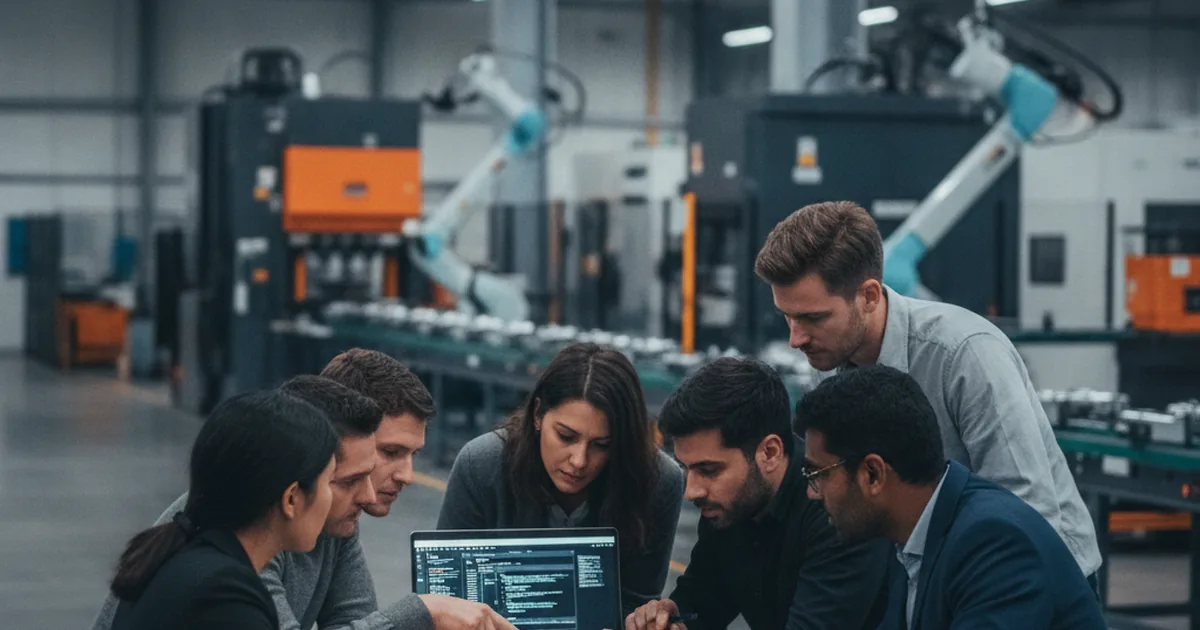
Three sourcing models exist for industrial mobile and IIoT software: in-house hiring, a one-off vendor project, and a dedicated development team. In-house is slow to staff and hard to keep busy between builds; a one-off vendor delivers fast but walks away with the context when the contract ends. A dedicated team works when the project is ongoing and the stakes of getting the domain wrong (OT/IT convergence, long equipment lifecycles, plant-floor conditions) are high. Run the 5-step checklist below before you commit to any model.
A plant manager wants a mobile app that lets field technicians log inspections offline and sync when they're back near a gateway. Six months later, that same team is asked to add real-time alerts from the SCADA layer, then role-based dashboards for three different shifts. Hiring an in-house mobile team for a single app is hard to justify, and the agency that built version one has already moved on to its next client. This is the sourcing problem behind most industrial connected-worker and IIoT mobile projects: the work doesn't stop after launch, but it also isn't big enough to carry a permanent headcount plan.
A growing number of manufacturers solve this by choosing to hire dedicated mobile app developers as an extension of their own engineering group, rather than choosing between a full in-house build and a disconnected vendor contract. That middle path keeps domain knowledge inside one team across releases, instead of re-explaining the plant's recipes, protocols, and shift patterns to a new contractor every time there's a new request.
This guide breaks down the three sourcing models for industrial software, what a dedicated team actually needs to learn about your factory floor, why teams without plant-floor experience tend to fail on this kind of project, and a 5-step checklist to run before you hire.
Three Ways to Staff an Industrial Software Project
Every industrial mobile or IIoT software initiative gets staffed one of three ways. Each has a real tradeoff: there's no universally correct choice, only a better fit for your project's shape.
In-house hiring
Building an internal team means hiring mobile developers, an IIoT or protocol engineer, and QA directly onto your payroll. You get full control over priorities and no dependency on an outside firm's availability. The tradeoff is time and utilization: a competitive mobile/IIoT hire can take two to four months to land in a tight talent market, and between major releases that headcount can sit underused unless your roadmap has steady, ongoing work to fill it.
One-off vendor or agency project
A fixed-scope vendor engagement gets a defined app built and shipped, often faster than standing up a hire from scratch. The risk shows up after launch: once the contract closes, the people who understood your sensor layout, your offline-sync edge cases, and your shift-handoff workflow are gone. The next change request, even a small one, starts with a new team relearning context that already existed once.
Dedicated development team
A dedicated team is staffed by an outside partner but works as a standing extension of your engineering group across multiple releases, not a single deliverable. You get continuity of domain knowledge without carrying the hire directly, and the team scales up or down with your roadmap instead of sitting idle. The tradeoff is that you're trusting a partner's bench rather than your own, which is exactly why vetting their industrial experience matters more here than in a generic web project.
| Factor | In-house | One-off vendor | Dedicated team |
|---|---|---|---|
| Time to start | Slow — 2-4 months to hire | Fast — weeks | Fast — weeks |
| Domain continuity | High, but you built it from scratch | Lost after the contract ends | Retained across releases |
| Utilization risk | High between major releases | None — pay per project | Scales with roadmap |
| Best-fit scenario | Large, steady long-term pipeline | A single, well-defined app with no planned follow-on | Ongoing mobile/IIoT roadmap without the hiring overhead |
What a Dedicated Team Needs to Know About Your Factory Floor
An industrial mobile or connected-worker project needs a specific mix of roles, not a generic app-dev squad. At minimum, expect mobile developers fluent in iOS, Android, or Flutter who understand offline-first design; an IIoT or protocol engineer who can work with MQTT and Sparkplug B or OPC-UA data feeds; and QA that tests under real plant-floor conditions: gloved-hand touch targets, barcode and RFID scanner integration, and intermittent connectivity between gateways. A team that treats these as edge cases rather than baseline requirements will ship an app that looks fine in a demo and breaks on the line.
Beyond roles, a dedicated team earns its value by learning your systems once and keeping that knowledge across every release: your MES or ERP data model, your existing sensor layout, and the shift patterns that determine when technicians can actually use the app without disrupting production.
Why Generic Offshore Teams Fail on Plant-Floor Projects
Generic outsourcing teams that are strong on consumer or enterprise web apps frequently struggle on industrial projects for reasons that have nothing to do with coding ability. OT/IT convergence is unfamiliar territory: a mobile app that reads live data from a control system has to respect network segmentation and update cadences that a typical web backend never has to think about. Equipment on the factory floor is often in service for ten to twenty years, so an app built against today's firmware version has to degrade gracefully, not break outright, when it meets a PLC from a decade ago. And compliance expectations around industrial control systems (see our ICS/OT security audit checklist for what that typically covers) are a different conversation than standard web app security, with implications a team unfamiliar with frameworks like IEC 62443 can easily miss. The result, when a team skips this domain context, is usually a round of expensive rework once the app meets real plant conditions.
A 5-Step Checklist Before You Hire a Dedicated Team
- Audit your existing systems first. Document the sensors, protocols, MES/ERP integrations, and legacy equipment the app will need to talk to before you ask any team to scope the work; vague requirements produce vague estimates.
- Run a paid pilot sprint before committing long-term. A two-to-four-week pilot on a real feature reveals whether the team's actual working style and output match the pitch, at far lower risk than a multi-month contract.
- Verify IIoT/MES experience with specifics, not buzzwords. Ask for named protocols, named plant-floor conditions they've designed around, and references you can actually call: "we've done manufacturing before" is not a qualification.
- Agree on a knowledge-transfer model up front. Define how documentation, architecture decisions, and system access are shared with your internal engineers so the team's knowledge doesn't become a single point of failure.
- Plan for long-term support, not just the first release. Confirm the team is staffed for an ongoing roadmap (bug fixes, firmware-driven changes, new shift requirements), not just the initial build-and-hand-off.
Teams running through this checklist are often best served when they hire dedicated mobile app developers who are already set up for staged onboarding and a pilot-first engagement, rather than a vendor whose default is a single fixed-scope contract. A build-vs-buy question shows up elsewhere in industrial software too: see our build-vs-buy framework for how the same tradeoff plays out when the decision is about MES software itself rather than the team that builds it.
FAQ
What does a dedicated development team actually do day to day?
A dedicated team works through your backlog the same way an internal engineering team would: sprint planning, code review, releases, but the developers are employed and managed by the outside partner rather than your company directly. You direct the roadmap; the partner handles staffing, bench depth, and continuity.
How is a dedicated team different from staff augmentation?
Staff augmentation typically means individual contractors slotted into your existing team and processes on a short-term basis. A dedicated team is usually a more cohesive unit, sometimes including its own lead or PM, engaged for a sustained roadmap rather than a single staffing gap, with more responsibility for outcomes rather than just hours delivered.
How long does it take to onboard a dedicated team to our factory systems?
As a rough range, expect two to six weeks for a team to get through system documentation, a pilot sprint, and initial access setup before they're producing release-ready work; longer if your systems are poorly documented or your plant runs several generations of legacy equipment side by side.
What should we ask about industrial/IIoT experience before hiring?
Ask which specific protocols they've integrated (MQTT, OPC-UA, Modbus), which plant-floor conditions they've designed mobile apps around (offline-first sync, scanner hardware, gloved touch input), and for a reference you can call at a company with a comparable production environment.
Can a dedicated team work alongside our in-house engineers?
Yes, this is one of the more common setups. The dedicated team covers mobile/IIoT development capacity while your in-house engineers retain ownership of core systems, architecture decisions, and security sign-off, with a defined handoff process between the two groups.
What's the biggest risk of choosing the wrong sourcing model?
The most expensive mistake is picking a one-off vendor for what turns out to be an ongoing roadmap: you pay for re-discovery of the same domain context every time a new request comes in, which costs more over two or three years than a dedicated team would have.
Evaluating a dedicated team for your next industrial mobile or IIoT project? Talk to a Dedicated Development Team →