
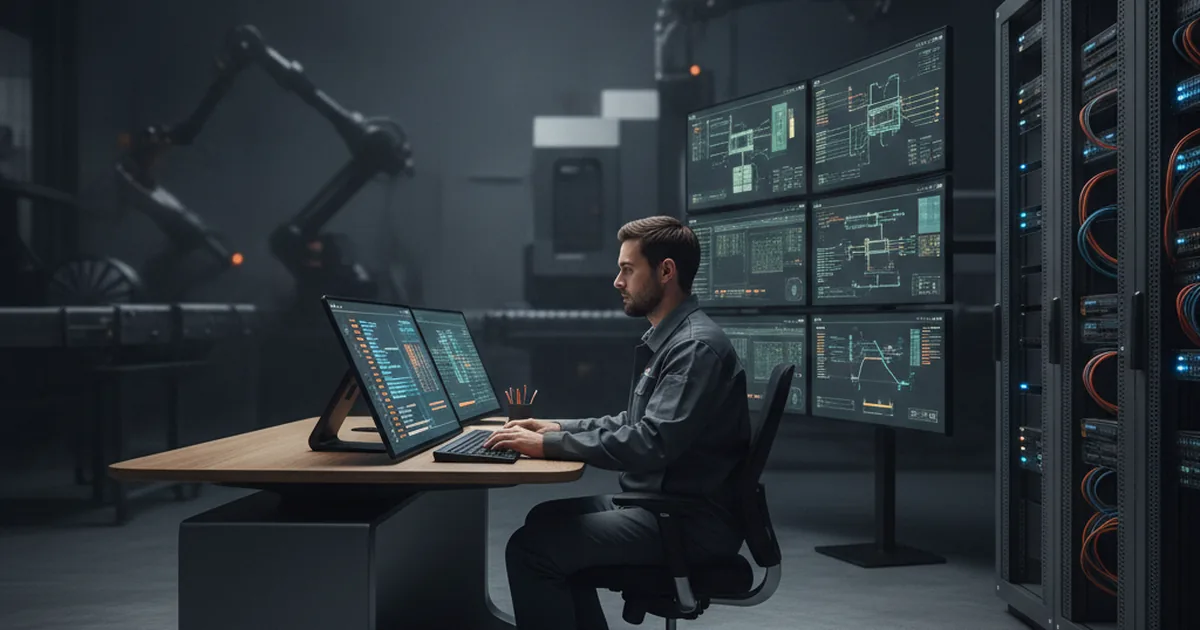
Industrial CI/CD adapts cloud-style continuous integration and delivery to PLC, SCADA, and MES deployments, where the deployment target is physical equipment instead of an ephemeral server. The main barrier isn't tooling — it's that a bad rollout can stop a production line or put people at risk. The practical starting point is a pilot on one line, with a simulation environment and clear rollback criteria defined before anything touches live equipment.
Most manufacturers adopted CI/CD years ago for their cloud and web software — automated builds, test suites, and one-click deploys are standard practice for IT teams. But the PLC logic, SCADA configurations, and MES integrations running the actual production line are still, in most plants, deployed the way they were a decade ago: manually, overnight, by an engineer who exports a project file, copies it to a USB drive or laptop, and uploads it to the controller while hoping nothing goes wrong on the next shift.
That gap is widening as OT and IT systems converge, and closing it usually isn't a software problem so much as a scoping and integration problem — getting version control, staging environments, and approval gates wired into an OT network without breaking the segmentation that keeps it safe. That's exactly the kind of cross-system build a team that builds these kinds of industrial CI/CD pipelines is set up to handle, since it sits at the intersection of application delivery and infrastructure that most in-house IT teams don't touch day to day.
This guide walks through why standard CI/CD practices don't transfer directly to the shop floor, what an industrial pipeline actually looks like stage by stage, the security and compliance gates IEC 62443 adds, the tooling that bridges IT and OT, and a practical checklist for piloting the whole thing on one production line before rolling it out further.
Why Traditional CI/CD Breaks Down on the Shop Floor
The assumptions baked into standard CI/CD tooling — spin up a fresh environment, run the tests, tear it down, repeat — don't hold once the deployment target is a physical machine.
Physical hardware vs. ephemeral cloud environments
A cloud deployment can provision an identical test environment in seconds and destroy it just as fast if something goes wrong. A PLC, robot cell, or SCADA-connected machine is a fixed, expensive, physical asset — there's no spinning up a second one to test against unless the plant has invested in a simulation or digital-twin environment specifically for that purpose. Without it, "testing in an environment that matches production" means testing on the actual production line, which is the exact risk a pipeline is supposed to reduce.
Safety-critical rollback requirements
Rolling back a web deployment means redeploying a previous build with no physical consequence. Rolling back a PLC program has to account for whatever physical state the equipment is in at that moment — a motion sequence half-completed, a valve open, a robot arm mid-cycle. A rollback plan for industrial systems defines a safe state to return the equipment to, not just a previous software version, and often needs a human confirmation step before the previous logic reloads.
What a CI/CD Pipeline for Industrial Control Systems Actually Looks Like
An industrial CI/CD pipeline keeps the same core shape as a software pipeline — version control, automated checks, staged promotion — but each stage is rebuilt around physical constraints.
Source control for PLC logic and SCADA configs
The starting point is treating ladder logic, structured text, and SCADA configuration files as code: committed to version control, reviewed before merging, and tagged to a specific release rather than living only inside a vendor's proprietary project file on someone's laptop. This alone — before any automation exists — gives a plant an audit trail and a way to diff what changed between two versions of a running process, which most shop floors don't have today.
Staged environments — simulation, test cell, pilot line, full production
Where a web pipeline might have dev, staging, and production, an industrial pipeline typically adds two more rungs: a software simulation of the process (fast, cheap, catches logic errors early) and a physical test cell or spare line (slower, catches timing and hardware-interaction issues a simulation can't). Only after a change clears both does it reach a pilot line in live production, and only after it proves out there does it roll to the rest of the plant. This is also where the gains from edge computing deployments show up — running the test-cell and simulation workloads on local edge infrastructure keeps feedback loops fast without routing every validation run through a distant cloud environment.
Hardware-in-the-loop testing before anything touches a live line
Hardware-in-the-loop (HIL) testing connects real controller hardware to a simulated process model instead of the physical equipment, so a new PLC build runs against realistic timing and sensor feedback without any risk to the actual line. It's the closest an industrial pipeline gets to the "test in an environment identical to production" ideal from cloud CI/CD, and it's usually the single highest-leverage investment a plant can make before scaling a pipeline past one line.
Security and Compliance Gates (IEC 62443)
Where a cloud pipeline builds in security scanning as one stage among several, an industrial pipeline has to treat segmentation and change control as the price of entry, not an optional add-on — IEC 62443 sets the baseline most regulated plants are measured against.
Air-gapped and segmented OT networks — what changes in the pipeline
Many OT networks are deliberately isolated from the general corporate network, and a CI/CD pipeline that wants to reach into that environment has to do so through a defined, monitored gateway rather than a flat connection that punches a hole through the segmentation. This usually means the pipeline's deployment stage runs through a jump host or a one-way data diode rather than a direct network path from the CI server to the controller — slower than a typical cloud deploy, but that's the tradeoff for keeping the segmentation intact. Teams modernizing the human-facing side of this stack at the same time should see our guide on modernizing the SCADA/HMI layer, since the two efforts share a lot of the same network-segmentation decisions.
Change approval and audit trail for regulated plants
IEC 62443 and most plant-level compliance regimes expect a documented approval step before a change reaches a live system, plus a retained record of who approved it and when. A CI/CD pipeline can enforce this natively — a merge or deploy simply can't proceed without a recorded sign-off — which in practice gives regulated plants a cleaner audit trail than the manual change-request spreadsheets most of them run today. The same discipline extends to communication security: see our breakdown of OPC UA security practices for how to secure the protocol layer a lot of these pipelines end up talking over.
Tools That Bridge IT and OT Pipelines
None of this requires exotic tooling — it requires adapting familiar IT tools to artifacts and targets they weren't originally built for.
Version control and CI runners adapted for firmware and config artifacts
Standard version control (Git) and CI runners (Jenkins, GitLab CI, Azure DevOps) can manage PLC project files and SCADA configuration exports the same way they manage application code, provided the team builds the export/import tooling to get those artifacts in and out of vendor-specific formats. That tooling — not the CI runner itself — is usually the actual engineering effort in a first industrial pipeline.
Where a dedicated DevOps partner fits in
Building that bridge — CI tooling that understands both software delivery and the constraints of a segmented OT network — is a narrow specialty that most plants don't have in-house, and most generalist DevOps vendors haven't built either. It's a reasonable point to bring in outside help scoped specifically to that integration, rather than trying to staff it from a general software team that's never worked against a live production line.
A Practical Rollout Checklist
Piloting industrial CI/CD on one line, in order:
- Baseline the current manual deployment process — document exactly how changes reach the controller today, including every manual step and who performs it, so you know what the pipeline needs to replace.
- Put existing PLC and SCADA configs into version control — even before any automation exists, this gives you a diff-able history and an audit trail you don't have today.
- Build a simulation or staging environment for that one line — this is the slowest step and the one worth front-loading, since every later stage depends on it being accurate.
- Define rollback criteria and a safe state — write down, in advance, what "something went wrong" looks like and what physical state the line needs to be in before the previous logic reloads.
- Pilot the pipeline on that one line — start with low-risk, easily reversible changes rather than a major logic rewrite.
- Monitor and gather metrics through a full production cycle — track deployment time, rollback frequency, and any near-misses before declaring the pilot a success.
- Scale the proven pattern to the rest of the plant — reuse the simulation and tooling investment from the pilot line rather than rebuilding it per line.
FAQ
- Can CI/CD really be applied to PLC programming?
- Yes, with adaptation. The core CI/CD idea — version-controlled changes, automated checks, and a repeatable path to deployment — applies to ladder logic and structured text the same way it applies to application code. What changes is the deployment target: instead of pushing to an ephemeral cloud instance, the pipeline pushes to a physical controller, so every stage before that push has to validate behavior against a simulated or test-cell twin of the real process first.
- What's different about rollback in an industrial pipeline vs. a web app?
- A web app rollback swaps a container or redeploys a previous build in seconds with no physical consequence. A PLC or SCADA rollback has to account for whatever physical state the equipment is in when the fault is caught — a partially completed motion sequence, an open valve, a robot mid-cycle. Industrial rollback plans define a safe state to return to, not just a previous software version, and usually require a human to confirm the line is clear before the previous logic is reloaded.
- Do we need to replace our PLCs or SCADA software to adopt CI/CD practices?
- No. Most CI/CD adoption in industrial settings works around existing PLC and SCADA platforms rather than replacing them. The pipeline wraps version control, automated testing against a simulation or test cell, and a staged deployment process around whatever controllers and SCADA software are already on the floor — the goal is a repeatable process for shipping changes, not a hardware refresh.
- How does IEC 62443 affect a CI/CD pipeline?
- IEC 62443 sets security requirements for industrial automation and control systems, and a CI/CD pipeline touching those systems has to satisfy them at each stage — change approval before a build reaches a live environment, an audit trail of who approved what and when, and controls that respect network segmentation between the OT environment and the IT systems the pipeline runs on. In practice this usually means a pipeline that can reach into the OT network through a defined, monitored gateway rather than a flat connection.
- What's a realistic timeline to pilot this on one production line?
- Most plants can get a meaningful pilot running on a single line within a few months, since the hardest work — building a simulation or test-cell environment that behaves like the real process — only has to be done once for that line. Version-controlling existing configs and defining rollback criteria typically take a few weeks each; the pilot deployment itself, including a monitoring period before calling it a success, is usually the longest stretch.
- Does this work for brownfield plants with legacy equipment?
- It works, but the simulation and version-control steps take longer. Legacy PLCs and SCADA systems often lack native export formats or version-control-friendly file structures, so the first real effort in a brownfield pipeline is usually building reliable tooling to pull current configurations into a repository and simulate them accurately — once that's in place, the rest of the pipeline looks similar to a greenfield rollout.
Need help building a CI/CD pipeline that actually respects OT network segmentation and safety requirements? Talk to a Team That Builds Industrial DevOps Pipelines →