
TL;DR: Sensor selection for an IIoT program should start from the failure mode you need to catch, not a vendor catalog. This guide covers the five core sensor classes — vibration, temperature, pressure, current, and machine vision — how to match each to an asset, wired vs. wireless trade-offs, placement rules, and what ROI actually looks like when the match is right.
Most plants that stall out on IIoT didn't fail because of the platform — they failed because the sensors on the floor don't answer the question maintenance teams actually ask: "is this specific asset about to break, and why?" That match also determines how data reaches the people who act on it; if your monitoring strategy depends on custom dashboards for shift supervisors, the sensor layer is where that pipeline starts clean or starts noisy.
Why Sensor Selection Is the Foundation of Your IIoT Program
An IIoT architecture can be perfectly designed — edge gateways, OPC UA, a clean cloud pipeline — and still deliver nothing useful if the sensors feeding it are the wrong type for the asset. A piezoelectric vibration sensor on a slow-moving conveyor roller swamps the system with irrelevant noise; a basic thermocouple on a precision spindle misses the bearing wear that fails the part weeks before temperature ever rises. The cost of a wrong sensor choice isn't the hardware — it's months of false alarms or missed failures before anyone notices the mismatch.
Match the Sensor to the Failure Mode, Not the Catalog
Start every sensor decision with the failure modes that actually hurt the asset. Imbalance and misalignment show up first as vibration at specific frequency bands. Bearing wear produces high-frequency vibration spikes well before audible noise or heat appears. Overheating from friction or electrical faults is a temperature-and-current problem, not a vibration one. Leaks and blockages in fluid systems are a pressure problem. And cosmetic or dimensional defects on a finished part are invisible to every sensor class except vision. Build the sensor plan backward from this list, asset by asset, instead of forward from a product brochure.
The Five Core IIoT Sensor Types
Vibration Sensors — Piezoelectric vs. MEMS vs. Eddy Current
Piezoelectric (PE) accelerometers remain the standard for high-frequency bearing and gearbox monitoring: wide frequency range, high sensitivity (measured in mV/g), and a long track record on rotating critical assets. MEMS accelerometers trade some sensitivity and range for lower cost, lower power draw, and wireless-friendly form factors — a fit for balance-of-plant equipment where PE wiring would be overkill. Eddy current proximity probes measure shaft displacement directly rather than casing vibration, making them the right choice for fluid-film bearings on large turbines and compressors.
Temperature Sensors — Contact Points and Hotspots
Thermocouples and RTDs mounted at known friction and electrical contact points catch overheating before it becomes a failure. Infrared spot sensors add coverage for hotspots that are difficult or unsafe to instrument directly, such as busbars and rotating shafts.
Pressure Sensors — Process Point Proximity
Pressure transducers need to sit as close as practically possible to the process point they monitor — hydraulic lines, pneumatic systems, filtration stages — because distance from the source introduces lag that can mask a developing leak until it's already affecting output.
Current Sensors — Upstream of the Motor Drive
Current sensors placed upstream of a motor drive give an early, low-cost signal of mechanical load changes and winding faults, often before a vibration sensor confirms the same problem — a cheap first line of detection across a large fleet of motors.
Vision Systems — Machine Vision for Defect and Anomaly Detection
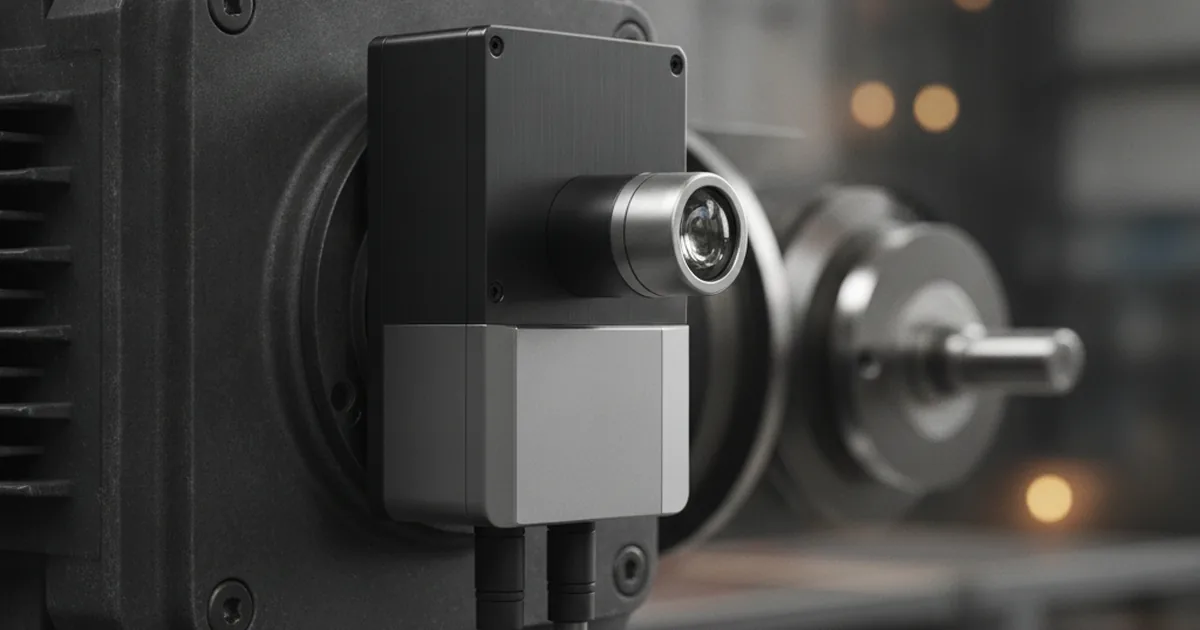
None of the sensor classes above catch a surface scratch, a missing component, or a dimensional defect on a finished part — that's the job of machine vision. A camera-based inspection station paired with an anomaly-detection model closes the gap that acoustic and thermal sensors leave open, and it's increasingly the sensor of choice for final-inspection stations that once relied on a human visual check. This is deep enough to deserve its own treatment on AI-driven quality control — worth watching for on this blog.
Wired vs. Wireless — Which Connectivity Fits Your Floor?
As a rule of thumb: wired PE sensors for the handful of assets where an unplanned failure stops the whole line, and wireless MEMS sensors for the much larger population of balance-of-plant equipment where battery-powered, retrofit-friendly installation matters more than squeezing out the last bit of frequency range. Processing that wireless sensor volume close to the source, rather than streaming everything raw to the cloud, is exactly the kind of workload edge computing was built to absorb.
Sensor Placement Rules That Actually Matter
- Mount as rigidly as possible. A loose bracket introduces resonance that looks like a bearing fault in the data.
- Shortest practical path to the source. For vibration and pressure sensors, distance and mounting compliance both distort the signal.
- Avoid noise sources. Keep sensors and cabling away from variable-frequency drives and high-current conductors that induce electrical noise.
- One axis is rarely enough on critical assets. Triaxial vibration coverage catches imbalance, misalignment, and looseness that a single-axis sensor misses.
Sensor Selection Checklist
Asset type → recommended sensor → priority
- Critical rotating equipment (main drives, compressors) — wired PE vibration + current + temperature — High
- Balance-of-plant motors and pumps — wireless MEMS vibration — Medium
- Large turbines, fluid-film bearings — eddy current proximity probes — High
- Hydraulic/pneumatic lines, filtration — pressure transducers near process point — Medium
- Final-inspection stations — machine vision — High for quality-critical lines
What ROI Looks Like When You Get This Right
Industry benchmarks for properly matched IIoT sensor deployments show up to a 70% reduction in unplanned downtime and fault detection roughly 6x earlier than reactive maintenance catches it. Plants reporting a well-executed rollout typically see ROI in the 3.3x range within 18 months, which tracks with how digital twin predictive maintenance programs compound the value of clean sensor data once it's flowing reliably.
Frequently Asked Questions
- What's the difference between a vibration sensor and an accelerometer?
- An accelerometer is the sensing element that measures acceleration; a vibration sensor is the packaged device built around it, including signal conditioning and mounting. Piezoelectric and MEMS accelerometers are the two most common types used in IIoT vibration monitoring.
- How many sensors does a typical production line need?
- It depends on criticality, not line length. A single critical asset may justify three or more sensor points, while balance-of-plant equipment may need only one wireless vibration sensor.
- Can IIoT sensors work without constant internet connectivity?
- Yes. Most industrial sensors buffer readings locally and sync once connectivity resumes, and many deployments route data through an edge gateway that performs analysis on-site.
- How accurate do industrial IoT sensors need to be for predictive maintenance?
- Accuracy requirements track the failure mode, not a single universal number — matching sensor spec to failure mode matters more than chasing maximum precision everywhere.
- How do sensor alerts integrate with existing CMMS/MES systems?
- Sensor platforms typically publish alerts over MQTT or REST to a middleware layer, which maps the event to an asset ID in the CMMS and automatically opens a work order.
Choosing the right sensors is only half the stack — someone still has to get that data in front of the people who act on it. The payoff of a well-matched sensor layer is a feed that turns into dashboards your maintenance team actually opens, not another data lake nobody checks.
Sources: Oxmaint, IIoT Sensor Selection Guide for Manufacturing Equipment Monitoring (2026); F7i.ai, How to Choose Vibration Sensors for Actionable Insights; Digital Matter, How to Deploy IoT Sensor Monitoring in Manufacturing and Industrial Operations.