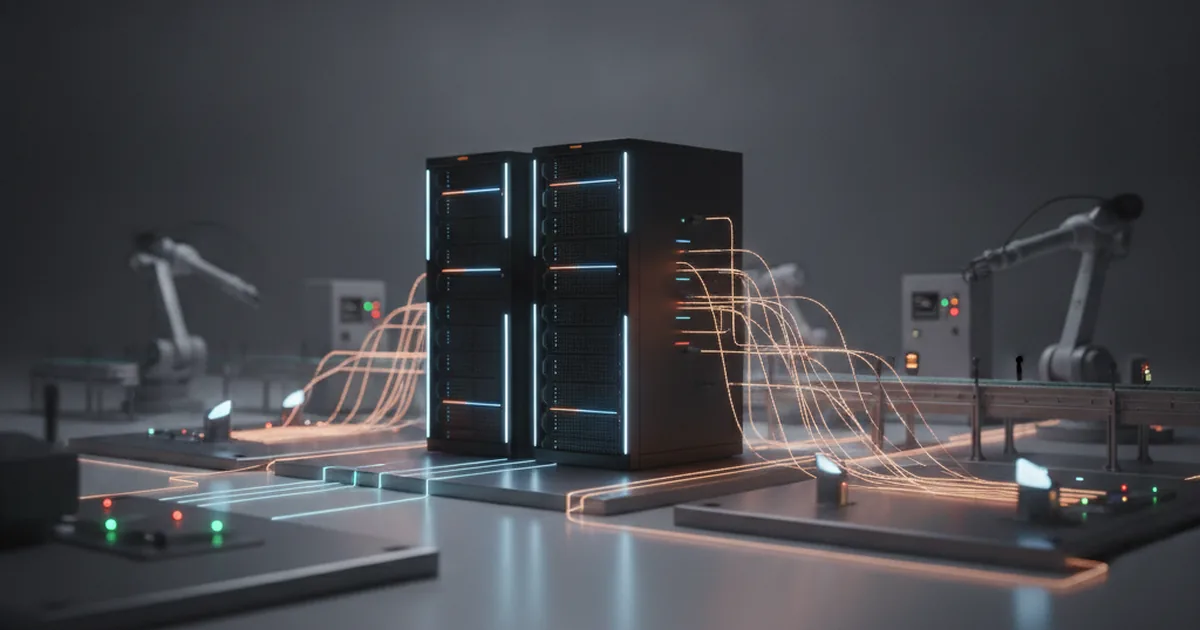
Manufacturing data lakes fail or succeed on architecture, not tooling choice. This guide walks through five layers — sensors, edge gateway, streaming ingestion, storage, and analytics — plus how to choose between time-series, relational, and lakehouse storage, and the three reasons most first attempts stall.
Most plants already generate more sensor data than anyone analyzes. PLCs, SCADA historians, vibration monitors, and machine-vision cameras each log in their own format, at their own frequency, into their own silo — and by the time an engineer wants to correlate a quality defect with a temperature spike from three shifts earlier, the two datasets live in systems that were never designed to talk to each other.
A manufacturing data lake solves that by giving every signal, structured or not, one place to land before anyone decides how it will be used. Getting the ingestion layer right is usually the hard part — it's also where a team that builds the ingestion APIs behind it earns its keep, translating OPC UA and MQTT payloads into endpoints the rest of the stack can actually consume. The rest of this guide covers the five layers that make that translation work end to end.
What Is a Manufacturing Data Lake?
A manufacturing data lake is a central repository that stores raw sensor, machine, and process data in its native format — CSV, JSON, images, time-series binaries — without forcing a schema at write time. A data lakehouse adds a transactional table layer (Delta Lake, Apache Iceberg, or similar) on top of that raw storage, which gives ACID guarantees and lets the same data serve both SQL dashboards and ML training without duplicating it into a separate warehouse.
Plants need this layer because shop-floor data has three problems a single relational database cannot absorb at once: volume (a single vibration sensor sampling at 25 kHz produces more rows per hour than most ERPs see in a year), velocity (control-loop and alarm data arrive continuously, not in nightly batches), and variety (structured PLC tags, semi-structured OPC UA messages, and unstructured vision-system images all need a home).
The Five Layers of a Manufacturing Data Architecture
Regardless of vendor, every working industrial data pipeline breaks down into the same five layers:
- Sensors & shop-floor sources. PLCs, SCADA historians, vibration and vision sensors — the systems that generate the raw signal in the first place.
- Edge gateway. Local filtering, aggregation, and anomaly pre-scoring close to the machine, so only relevant events — not every raw sample — leave the plant floor. Our guide to edge computing in manufacturing covers how this tier cuts both latency and bandwidth.
- Streaming ingestion. MQTT or Kafka carries events from the edge gateway into the lake reliably, even across unreliable plant networks. See our MQTT and Sparkplug B protocol deep dive for how namespace and birth/death certificates keep this layer trustworthy.
- Storage layer — data lake / lakehouse. Raw data lands first (commonly called the "bronze" tier), gets cleaned and conformed into a "silver" tier, then aggregated into business-ready "gold" tables — a pattern known as medallion architecture.
- Analytics & ML layer. Dashboards, predictive models, and APIs that read from the gold tier to answer questions like "which bearings are trending toward failure this quarter."
Choosing the Right Storage: Data Lake vs Time-Series vs Relational
No single database type covers every manufacturing workload well. Most mature architectures run two or three in parallel — a pattern sometimes called polyglot persistence — rather than forcing everything into one engine:
| Storage type | Best for | Limitation |
|---|---|---|
| Time-series DB | High-frequency sensor streams, real-time dashboards | Weak at complex joins across unrelated entities |
| Relational DB | Work-order metadata, transactional MES/ERP records | Doesn't scale economically to raw telemetry volume |
| Data lake / lakehouse | Mixed formats, long-horizon retention, ML training data | Needs active cataloging or it degrades into a "data swamp" |
Common Use Cases Once the Data Lake Is in Place
The architecture itself delivers nothing until it feeds a use case. The most common first wins once ingestion and storage are reliable:
- Predictive maintenance — correlating vibration, temperature, and current-signature trends to flag bearing or motor wear before failure. See our digital twin for predictive maintenance guide for the modeling layer that sits on top of this data.
- Quality and defect detection — joining vision-system results with process parameters to find which settings correlate with scrap.
- OEE tracking — combining machine-state logs with scheduling data to compute availability, performance, and quality in near real time.
- Energy monitoring — aggregating meter and compressed-air sensor data to flag waste that a weekly report would miss.
Why Do Manufacturing Data Lake Projects Fail?
Most failed data lake projects share one of three root causes, not a tooling mismatch. No edge pre-processing means every raw sample — useful or not — gets pushed to the cloud, overwhelming bandwidth and storage budgets within months. No data catalog turns the lake into what practitioners call a "data swamp": files pile up with no documented schema, and engineers stop trusting — then stop using — the lake. No clear data owner on the shop floor means sensor naming conventions drift, tags get renamed without notice, and downstream models silently break.
Frequently Asked Questions
- What's the difference between a data lake and a data lakehouse in manufacturing?
- A data lake stores raw files — sensor logs, images, CSV exports — in their native format with no enforced schema. A lakehouse adds a transactional layer (such as Delta Lake or Apache Iceberg) on top of that raw storage, giving ACID guarantees, schema enforcement, and the ability to run both SQL analytics and ML training against the same tables. Most new manufacturing deployments start as lakehouses rather than plain lakes, because shop-floor data quality problems surface fast without schema enforcement.
- Do I need Kafka or is MQTT enough for shop-floor data ingestion?
- MQTT is usually sufficient at the edge: it's lightweight, built for unreliable networks, and natively understood by most PLCs and gateways. Kafka typically sits one layer further in, as the durable, replayable backbone that fans sensor streams out to storage, analytics, and ML services at once. Many architectures use both — MQTT from machine to edge broker, Kafka from edge broker to the lake.
- How much historical sensor data should a manufacturing data lake retain?
- Retain raw high-frequency telemetry (vibration, current signature) for as long as your predictive-maintenance models need to see a full failure cycle — often 12–24 months for slow-developing faults like bearing wear. Downsampled or aggregated data (hourly OEE, daily energy use) can be kept indefinitely at low cost, since lake storage is cheap compared to a time-series database at the same retention.
- Can a manufacturing data lake work without cloud infrastructure?
- Yes. On-premises object storage (such as an S3-compatible appliance) combined with an open table format like Iceberg or Delta Lake gives most of the lakehouse benefits without sending data off-site. This is common where data sovereignty, air-gapped OT networks, or bandwidth constraints rule out continuous cloud sync — though it shifts the hardware and scaling burden onto the plant's own IT team.
- What skills does a plant need in-house to maintain a data lake?
- At minimum: someone who understands OT protocols (OPC UA, MQTT) to keep ingestion reliable, a data engineer comfortable with ETL/ELT pipelines and a catalog tool, and an analyst or data scientist who can turn stored data into dashboards or models. Smaller plants often start by outsourcing the pipeline build to a development partner and keeping only day-to-day ingestion monitoring in-house.
Need help building the ingestion APIs behind your data lake? Discuss Custom API Development →
Sources: Databricks, How to Build Scalable Data and AI Industrial IoT Solutions in Manufacturing; HiveMQ, IIoT Data Storage and Actionable Analytics Generation; AWS, Manufacturing Data Lake Reference Architecture.