 Smart Machines & Factories Editorial Team
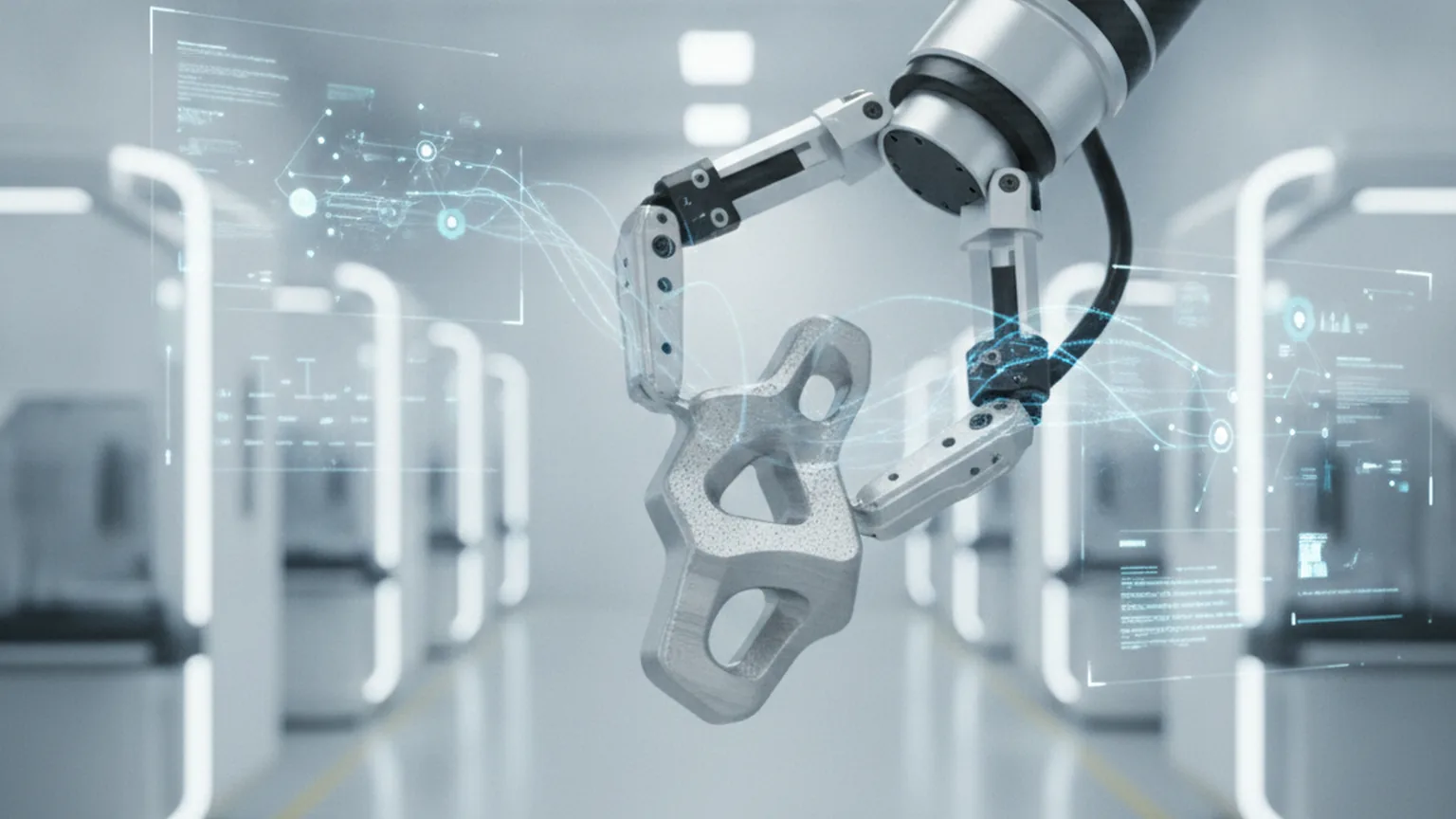
Siemens is showing an end-to-end Digital Thread at Formnext 2026 (November 17-20, Frankfurt) that lets engineers generate a custom, 3D-printed robot gripper by describing the object and task in plain language, instead of manually redesigning the gripper for every new part. Developed with humanoid-robotics company AGIBOT, the agentic AI workflow selects a gripper type, adapts its geometry in Siemens' Designcenter, runs simulations, and validates interfaces, then hands the finished design off as print-ready data for additive manufacturing. Karsten Heuser, Siemens' VP of Additive Manufacturing, said the point is to replace a "time-consuming" manual design cycle with an agentic workflow that "can orchestrate engineering tasks based on specific requirements."
From Prompt to Production Floor
Siemens Agentic AI and Additive: Key Facts
- Gripper design workflow. Built with AGIBOT. The user describes the object and task, and the AI agent selects gripper type, adapts geometry, simulates, and validates it, so there's no manual redesign per part.
- Erlangen production cell. A new adaptive cell at Siemens' Electronics Factory combines additive manufacturing, automation and post-processing, built jointly with EOS and AM Solutions.
- Tooling. AM I Navigator, now enhanced with Industrial AI, helps companies prioritize where to apply additive manufacturing across design, engineering and production.
- Event. Formnext 2026, Frankfurt, Hall 12.1, Booth 119D, Nov 17-20.
The Erlangen cell is the manufacturing-side half of the same idea. Once a design like the AI-generated gripper exists, the cell is meant to handle varied part geometries on one production line while keeping output repeatable, with downstream finishing from AM Solutions built in rather than bolted on afterward. That matters because additive manufacturing has historically struggled to move from one-off prototypes to repeatable, scheduled production runs, and an adaptive cell with integrated post-processing is built to close exactly that gap.
Why This Matters Beyond Siemens Hardware
The underlying pattern is simple: describe intent, let an AI agent handle the engineering steps, and validate the result before committing to physical production. It's the same shift already playing out in PLM, MES and scheduling tools across the industry. For manufacturers, the practical question isn't whether to adopt agentic design tools from a single vendor, but how to connect them to the plant's existing quoting, ERP and production-tracking systems once a part moves from "designed by an AI agent" to "ordered, built, and tracked." That's the kind of custom manufacturing software development work that turns a vendor demo into a repeatable shop-floor process rather than a one-off pilot.
Sources: Automation.com, November 17, 2026; IoT Now, November 17, 2026.